It is interesting to look at the amount of debate kicked up by the recent "overview of living standards" released by the MSD, in a different context. The report highlighted how it is not the absolute income of a familial grouping that determines their final living standard, but is just as closely linked to the income sources and decision making of those familial groups in terms of their income disposal.
In that respect I would turn your analysis to the same debate, but using New Zealand and Australia as test subjects, rather than New Zealand family units. In that respect I would point out that it is still the continuing wasteful monetary mind sets of both the New Zealand Government and general public that would doom us to a continuing relative decline in living standards, despite our recent closing of growth rates.
Australia is currently in the process of implementing a change to their superannuation scheme such that wage / salary earners will be saving at the rate (opt-out) of 12% of their pre-tax income. Even if they opt-out of the 12% rate they will still be saving a compulsory 8-9% pre-tax. Contrast this to the New Zealand situation of 4% opt-out, an optional 8% opt-in, or a 0% if you would still like. The wealth generation difference of the Australian situation running between 9% - 12% of their salary / wage income versus New Zealand's prospective 4% savings (household savings are still negative so the superannuation stands as the only incrementing savings pool) means that the Australian capital pool will be increasing at a rate of double to treble our own.
Even most of New Zealand's financially illiterate citizens should be able to understand that if you start with a greater capital base, and then continue to add to that base faster than your comparative position, you will quickly and irrevocably be in an unassailable position.
Even more than fighting our internal issues of beneficiary entitlement mindsets, bloated local Government bodies and high child abuse rates, we need to realize as a country that we need to start building a wealth base. Otherwise we will continue to lose on the living standards scales, and beyond not being able to support those other Pacific nations that depend on us, we won't even be able to support ourselves.
Tags: nz, newzealand, wealth, capital, investment
Thursday, July 13, 2006
Widening income and living standard disparities


Wednesday, July 05, 2006
Maori kill 945 children
In the wonderful thinking of our current Government it is most important to tell every potential Maori by Television ad that they have the opportunity to register on a separatist roll. The fact that around half of Maori continue to not want to register on this roll in itself would question the point of its existence.
But more importantly at present is the waste of a further 945 lives (ECU's) in the attempt to make this artifact of separatism more relevant. Somehow it seems more important to play around with the demographics of our electorates to the point of 945 lives. Please tell me why?
Tags: ECU, Maori, Maori roll, election
Everybody else just lives where they can afford to...
There seems to be this interesting philosophy that while people who work to survive must put up with living both:
a) in the locality of their job and
b) in housing that they can afford to
that beneficiaries are somehow above this.
Ngapuhi Social Services chief executive, Arapeta Hamilton, says many Maori families group together, especially in high-rent areas such as Auckland, because it is the only way they can survive.
This is definitely not the first time that I have seen these sentiments exhibited - in fact another example that comes to mind is:
"The woman living in the most expensive state house - on land valued at $1 million - had been there five years and said if the property was sold, she would have to be relocated in the same area." (NZ Herald - original article no longer available)
A similar one could be:
"At a hastily arranged meeting days after the occupation, the then Ngati Whatua trust board, unwilling to call in police to deal with people who were essentially family members, offered the group houses in Glen Innes. The offer was rejected. "Like hell. I'm not going to give up a million-dollar view to look at railway tracks," says Anderson." (NZ Herald - original article no longer available)
Can anyone give me a coherent argument why we should continue to support the idea of people living in housing that they cannot afford so that they can be in areas in which drug and alcohol abuse is high? It is already a posit of the above situation that these people are not in this locality because of jobs...
Tags: nz, newzealand, benefits
Tuesday, July 04, 2006
Rates used to further extend welfare net by stealth
Hattip: NZ Herald
Hattip: Labour Party Mailer
The New Zealand Herald article today had an interesting quote from Mike Reid raised my ire over an issue that had already been sparked by a Labour Party communication we received mailed out to us this week (more on that in a moment....):
Local Government New Zealand spokesman Mike Reid questioned whether Mr Carter's list was truly random and said rates rises varied around the country. The rates rebate scheme's new threshold meant rebates of up to $500 for people with incomes up to $20,000. That was bigger than any of the rises, he said.
This shows the philosophy that is endemic throughout the Labour party - that they can just keep extending the welfare net upwards through society by increasing levies and taxes to the point where the general populace cannot sustain the payments, and must pay for them through levies and taxes from other people. It needs to be recognized that it is not OK for rates and the like to be pushed upwards to levels at which those people still paying their rates must also start paying for everybody else's as well. Especially when the rates levied in the first place are nothing to do with a user pays basis but are already a subsidization in and of themselves.
The Labour party mailer I received posted out to me earlier this week (yes - complete with parliamentary crest....) was already proudly proclaiming their increased rates rebates availability and that it would now be available to 350,000 households in comparison to the 4,500 households last year. To me this is actually showing how incompetent the Labour Government in its governance of councils and their responsibilities has become. Labour either need to endorse the method of using rates to fund local Government, or be honest (sic) and start funding these services directly from central taxation.
Which method would you prefer - or what assumption would you challenge?
Tags: nz, newzealand, rates, tax
Quote of the day
Hattip: Dilbert Blog
Scott Adams regularly makes my day. But quotes that bring me close to snorting my morning coffee are worth sharing:
"And what’s up with the people who pray for material things? If you believe that God answers prayers for merchandise, it means the gap between the Almighty creator of the universe and Walmart is closing. God still has the lowest prices and widest selection, but how long can that last?"
Tags: dilbert, Scott Adams, humour
Inequalities of a tiered tax system
Tax return time always tends to refocus ones mind on the taxation system and its implications. One that crystallized quite clearly for me this tax period was how the tiered tax system actually conspires against the poor to keep them in their place.
It is a counter-intuitive point but as one moves through the levels of the taxation system it becomes easier to do the "right" things with your money, investing more and delaying consumption, thus escalating the rate of wealth growth. In addition you are better off doing the right thing by way of insurance etc so that the downside risks are also covered better than in a poorer household.
To demonstrate the partial point I will use the case of income protection insurance - something that most households know that they should have to some level, and yet those at most risk of the consequences tend not to have.
This is due to two compounding factors:
a) the cost of a given level of protection is higher for a low income worker
b) the level of Government subsidy is higher for a high income worker
The first is an understandable effect of the risk to the insurance company - but as long as the level of insurance is less than 80% of the original income actually tends not to be overly significant in the final calculation. In a specific instance where I earn double what someone else does, but we have the same level of insurance cover the premiums only differ by 15%. Most of that difference is due to them being a smoker - not the income disparity...
However where the big difference comes is that I can claim 39% (actually 51.5% - but I'll ignore the effects of GST registration for now) of my premium back from the Government. My specific comparison can only claim 19% of their policy back.
And so the Government through a tiered tax system acts to encourage those low risk individuals to partake in behaviors beneficial to themselves; while those high risk individuals are left to cope with their bad habits on their own.
Can you define a single behavioral encouragement within a tiered tax system that actually encourages low wealth / income families into those behaviors that will ultimately benefit them?
Tags: nz, newzealand, tax, wealth, investment
Monday, July 03, 2006
Road Noise Testing
Hattip: Scoop
For once I actually agree not only with the intent of some new legislation, but mainly agree with the proposed implementation. Harry Duynhoven has done well with his amendment to the Land Transport Rule: Vehicle Equipment 2004 to restrict the noise levels of vehicles. Not only are they actually bringing clarity to what is a noisy vehicle by the setting of absolute decibel levels, but they are actually implementing a regime in which they can be tested in a meaningful and consistent manner (through the Warrant of Fitness testing process).
However there is one point that I think is missed in all of this - the lax enforcement of non-warranted vehicles on the road. With the introduction of one more thing for an old / modified car to fail it will be interesting to see how much this already evident issue escalates. This is without even considering the fact that the types of mechanics etc that actually perform these types of modifications etc in the first place actually have a vested interest in just telling their clients to come back to them for their WOF (wink, wink).
Much like the issue with the micro-chipping of dogs the first issue that needs to be solved is the compliance and monitoring of the existing rules and regulations. If we cannot even enforce those properly then what chance is there of the tighter regulations actually having the desired effect? Or is this really just intended to be another way of funneling revenue into the Governments coffers anyway?
Tags: nz, newzealand, car, WOF
Friday, June 30, 2006
Deposits and Mortgages are not saving!
A few weeks back there was some feel good research published by the Westpac bank that purported to show that Aucklander's saving habits weren't as grim as thought.
In particular when this was reported by the MSM emphasis was placed on:
The independently conducted research shows that nearly half of Auckland savers claim to save regularly, with just under half aiming to increase their contributions to their nest eggs in the future. On average, the sample group were saving nearly 22% of their monthly income, but would ideally like to make this 32%.
Typically, more than a third of savers (35%) were salting away more money now than they were a year ago. What’s more, nearly 50% plan to increase their savings contributions over the next three months, compared with just 21% who plan to save less.
And from there the feel good wrapper was made. However what really needed to be focused on was the target of these "savings": 18 – 35 saving mostly for mortgages and deposits, and the 55+ cohort for retirement.
First - it is disturbing that the main group saving for retirement was the 55+ age group, if this is when you start saving for your retirement you have big problems. In fact whatever you salt away in the last 5 years or so of work is really going to have no appreciable effect on your retirement standard of living.
Secondly - and potentially more importantly - is the point that saving for a mortgage or deposit on a TV is not really "saving" in respects to the type of saving that New Zealand needs, it is avoiding a Hire Purchase Agreement. While this is to be lauded - it is frequently better for us to delay buying something until we can actually afford it - it is not saving in terms of building wealth, and building the wealth store of the country.
That involves "saving" without a purpose - it involves building up your personal reserves without a spending target in goal, improving your asset and earning base. The mind set that "saving" is something you do until you spend it is a major factor in New Zealand's continuing decline in OECD living standard comparisons, because we are never building our wealth on a permanent basis. We may temporarily save - but only until we hit some benchmark that we can now buy that TeleVision / House / Holiday. As a society we need to divorce our thinking that saving for the purpose of spending is a good start - but definitely not the end goal.
What proportion of your income do you actually save? And what do you put away to buy things?
Tags: nz, newzealand, saving, finance
Thursday, June 29, 2006
A new currently favourite author
Been in Melbourne for the first part of this week - which I will try and use as an excuse for my week-daily blogging dropping off (even though it has been a problem for a fraction longer than that...)
But despite this being a business based trip and therefore seeing very little of the city to which I was visiting there was one definite upside to the trip - I now have a new prodigious author that I can concentrate on devouring for a while.
The claim that he is a new favorite I suppose is a fraction strong - it will take a while before I would actually give anyone pride of place above Frank Herbert, Isaac Asimov and Dennis Wheatley; but having finished all of their works there is the issue that they cannot be my favorite author in terms of current reading. It looks like Iain M. Banks with "The Algebraist" might have made himself that new author.
When you can sit for two whole 4 hour flights reading non-stop both times you know someone has captured your imagination. At the very least I would recommend this book to any one who passably likes Sci.Fi; and I'm sure I'll be able to update you on his other books soon ;-)
Tags: Iain M. Banks, The Algebraist, Iain Banks, books, recommend
So when is Maori not Maori?
Apparently whenever it comes to pointing out that their culture is currently also made up of patricide and welfare dependency.
In the wake of the (yet another) dead child tragedy the response of the (publicly vocal) Maori community has somewhat interested me. It is always somewhat strange that Maori are fully willing to accept "responsibility" for the outcomes of their culture when it comes to the acceptance of more money. Whether that be through targeted welfare, targeted scholarships, cultural donations etc. And oddly enough even when that money is specifically being targeted because of Maori's over representation in crime and poverty statistics. In fact the number of public outcries from Maori interest groups that more money needs to be poured into the Maori community to 'solve' these issues (and atone for past crimes against the Maori culture) tend to be unceasing.
And yet when a specific instance of how the current Maori culture is self-destructing itself is brought up in the media the calls from these same groups is that this is nothing to do with their being Maori, and this is a general societal problem that we must come together as a community to solve.
I just wonder whether they recognise their own hypocrisy in claiming that these issues are Maori specific and therefore they need more money to solve them (otherwise it would need to be spent on society not Maori) - but that the specific instances are nothing to do with being Maori at all?
Tags: nz, newzealand, Maori
Thursday, June 22, 2006
It's the responsibility stupid!
Yet again we are subjected to reading about a highly preventable tragedy (NZ Herald: Drink-driver who hit teen jailed) if only our society could realise that a persons responsibilities take far more precedence than their "rights".
Now we have a teen who was hospitalised for 7 weeks, is lucky to be alive, must now live with a dental plate and has a torn liver. All because our society / legal system supports the rights of the driver above their responsibilities.
Ostensibly we have it reported that a 3 year sentence handed to this driver sends a hard message about drink-driving - it does nothing of the sort. If this was the drivers first offence, maybe. But this driver was not only drunk, he was banned from driving. To me that makes the severity as high (if not higher) than attempted murder. This driver was intentionally using a deadly weapon for which he had no licence, and nearly killed someone. The intent, and means were there - he should have to face the real consequences of his actions.
But furthermore it should never have got that far anyway. That it took 4 drink driving offences before this mans licence was revoked is stupid beyond belief. Depending on severity maybe give a warning the first time, if you are very liberally minded maybe 2 warnings. 3rd time for that type of offence it should be gone.
But then the worst was to follow. He was charged 4 times (yes, another 4) with breaching that ban - at least one of those with another drink driving offence. Personally driving without a licence (especially if it has been revoked / disqualified) by itself is tantamount to using a deadly weapon without a license. This is no different to going into a public area pointing over the heads of a crowd and discharging it. Drink driving without a license is tantamount to attempted murder even if they didn't hit anyone.
And what is most sad is the number of cases exactly like this that we see every week - where someone is seriously injured or killed by a disqualified driver who has previously been caught driving while disqualified. The use of deadly things like cars is a privilege, not a right, and breaching your responsibilities around that right needs to be taken very seriously; if people cannot handle their responsibilities we need to start removing rights - and apparently we need to remove more rights than the responsibilities gave. Then people might start understanding consequences.
Given that a disqualified driver is very likely to be impacting on your own right to live, what do you see as appropriate rights removal from them?
Tags: nz newzealand rights responsibilities
Wednesday, June 21, 2006
Inane post for the day
Yay - tomorrow is the shortest day of the year. For some reason I always like the shortest day as it indicates the promise of the gradual improvement in daylight hours from that point forward. The paradox that it indicates the coolest days of the year are still coming doesn't tend to phase me too much - especially as that cannot be guaranteed whereas the rate of change in the hours of our days is completely definable and measurable.
It is kind of depressing thinking about this though how much of a mathematicians mindset I have - especially in the area of calculus; I am obsessed with the tiny rates of change that make up our lives. And worst I derive much of my pleasure from watching this infinitesimal changes more than I do the larger changes / events around them.
I can tell you what the current rate of change in our mortgage payments are faster than I could tell you my age. Scarily I can actually tell you the acceleration (the rate of change in the rate of change) in our mortgage repayments - and I know how much we would have to be repaying per week for this to reach a 1c per repayment acceleration.
So while I am watching the changes in seconds of visible daylight that we start to enjoy again - what are you watching or waiting for?
Tuesday, June 13, 2006
An important question for New Zealand to ask itself
Hattip: Slashdot
"The controversial genius developer/writer/entertainer Paul Graham writes an insightful piece on Why Startups Condense in America. Here's the skinny: "The US allows immigration, it is a rich country, it is not (yet) a police state, the universities are better, you can fire people, work is less identified with employment, it is not too fussy, it has a large domestic market, it has venture funding, and it has dynamic typing for careers. Inquire for details within."
Given that New Zealand's future prosperity lies in capturing a healthy slice of the technology and finance wave, how do we compare on the above factors? Should we be trying to capture the innovation of small startup firms, or looking to lure larger more established players? Or do you disagree entirely and see New Zealand's GDP growing from other areas - if so what?
Tags: nz, new zealand, venture, entrepreneurship, finance, technology
New Zealand - Welcome to your world
Yesterday, more than any day in a long time, I got to feel like we were living in a second world country (I refuse to denigrate the plight of those in truly third world countries, despite that being the first term that comes to mind).
While we in Auckland got to experience another day without power, with the futile promises of TransPower that everything would be back within 2-3 hours, Wellington got cut off from the rest of the north island again - this time by a slick of vegetable oil across its single road out of town, and the South Island in general lost power and roading!
So what percentage of the country yesterday (people or geographical) actually had access to both power and mass transport? It is a pretty sad situation when that answer drops out of the telco measure of triple 9's into what I would posit was well less than 80%.
The first thing I think is important to reflect on is actually how well most of the country acted yesterday. Oddly enough most people were cheerful, courteous and helpful. My local bakery stayed open solely to act as an EFTPOS terminal for the Chemist and Fruit Store (they had no stock to sell so it wasn't for themselves) as they were probably one of the few places in Auckland that people could try and get their hands on that antiquated measure of currency - physical money. Despite 300 traffic lights being out there were remarkably few crashes (and despite the occasional lunacy in driving habits). It is a peculiarity of New Zealand that it seems to take "crises" like this to bring out our inner spirits again and show who we are and could be as a nation.
The second thing that is important to reflect on is how we have let our infrastructure stagnate to its present state. Please note it is important to differentiate between stagnation and denigration. Successive Governments are to blame for this, of that there is no question in my mind. However it is up to the present Government to actually do something about it, but do it in a way that does not penalize the current tax payers for their own shortcomings. It is important not to focus on how this Labour Government has had 9 years to do something about improving infrastructure and has so far failed; just as it is important not to focus on how the previous National Government did not succeed in this area during its terms in office. What is important to focus on is that it is unacceptable for this situation to continue and the investment needs to come now and continue into the foreseeable future.
What were your experiences and thoughts from yesterday?
Tags: nz, new zealand, auckland, power, snow, wellington
Friday, June 09, 2006
A sad loss for Hamilton and New Zealand
When SSA Global announced in march last year that they were going to open an RFID center of excellence in Hamilton, it appeared that New Zealand had actually secured a real path towards becoming a high technology value partner in a worldwide core growth area. For an economy that desperately needs to find more exports, and improve its labour productivity, RFID research and production could provide a huge boost. Along with promising entrepreneurial startups like Sandtracker already providing some capability in this area a partnership into the ERP world would have provided a perfect lever into the marketplace for the full scope of this new realm.
Furthermore given that the agricultural industry still looks like the most likely to implement supply chain wide implementation of tags in a value-added relationship for all parties (despite Walmarts strong arming their suppliers into slap and ship tagging), New Zealand looked like a true contender with the appropriate partnerships and funding in place.
Unfortunatly SSA Global has recently announced that it is pulling out of the venture so these hopes may go unrealized. I hope that Industry New Zealand, Hamilton City Council, WEL Energy Trust, Trust Waikato and B2H are able to find another partner of SSA's calibre to keep this proposal on some kind of track, as the potential rewards for New Zealand could be huge, and would represent more than just rhetoric in the progression of our economy towards a true technology based economy with the benefits of grounding in manufacturing as well as information exporting.
Personally this probably has more to do with SSA's acquisition of Baan Company and Baan products than the economic climate in New Zealand or the cited reasons of RFID cost / growth curves - but either way Hamilton and New Zealand are the losers.
Tags: RFID, nz, new zealand, SSA, Hamilton
Wednesday, June 07, 2006
Employment Grievance Lottery
Hattip: Scoop
There still seems to be a number of people in the community and political sphere that maintain that our employment dismissal laws are sufficient and clear. However in the above article from scoop the following caught my eye:
“Hurt and humiliation awards ranged from one Member awarding an
average $8,933 with 62 per cent in favour of employees, while another Member awarded an average $2,150 with a 38 per cent in favour of employees.”
It may actually be used to argue both in the favour of employers having too much leniency or employees having too much protection - however I would just use this to show that the required procedures are too complicated and unclear. If even the judges trying the dismissal cases cannot seem to agree about the bounds of unfair dismissal to the tune of damages differing by a factor of 4, and a 24% difference in outcomes then both employee and employer cannot have any certainty in the process protecting their rights. Both must feel some trepidation; the employer being worried if they can ever actually let someone go, and the employer whether they could be fired without justification.
Wayne Mapp's probationary employment bill will assist in this matter - but only by making the rules very clear for the first few months. After that the employment relationship re-descends into the current mire, where neither side is 100% sure of where they stand. I would see that we need to pass the probationary bill, and then move to make the whole process clearer and simpler for the entire employment period.
What do you see as the current problems with the employment dismissal procedures? And are they weighted too much in the employer or employees favour?
Tags: Wayne Mapp, employment, nz, new zealand, dismissal
Tuesday, June 06, 2006
IE Killer Feature for blogosphere addicts
With an extension for Firefox (although you can use a bookmarklet in IE / Firefox / Opera / Other) it allows you to track your blog comments and, increasingly, the conversations around those. So from a centralised point you get to see both the conversations you have been commenting on - and the activity that has been occurring on those conversations. In context.
I have found this far better than RSS where you get overloaded, and feedburner / email updates etc where the conversations lose context very quickly.
At the very least even for blogs that don't send updates it manages the permalinks for you so you can return to those conversations that you were flaming recently and see if the troll has taken the bait yet ;-)
Tags: blogging, blog, coComment, firefox[update] Of course the other point to bring up is for you blogger users out there (like me): Turn off the pop-up comments option!! While it doesn't prevent us using coComment it does make it more work (I.E. some rather than being automatic). And surely you wany to look after your visitors - especially those leaving comments?
A bad sporting weekend (not a repeat post)
As a companion post to; A good sporting weekend, A bad sporting weekend
Well the results of the teams I support all seemed to swing the wrong way this weekend:
Warriors play great football but just don't have the luck to topple the top of the table Bronco's. Darn - playing top of the table is normally when they can win! Still watching the game from a corporate suite on halfway certainly made for a good spectacle!
All Whites lost 4-0 against Brazil - not a bad performance I suppose, but you really do wonder if we could have kept it to 2-0 if Neilsen hadn't broken his leg!!
And most importantly we lost our soccer 4-1 (yes again), a bad performance if I do say so myself. And I can't take comfort in that I was on the bench for this one (because I wasn't) so cannot blame it completely on others ;-)
Although I might start blaming it on one of our center backs who cannot seem to stay in that position and plays a bit more center-mid. And therefore not surprising that all 8 goals over the last 2 weeks have come straight through the middle...
On a further downside we lost our best striker to torn ligaments in the first 5 minutes, so he won't be back this season!
Tags: soccer rugby league sport soccer2, brazil, new zealand, All Whites
Thursday, June 01, 2006
Tax Freedom day today - Every body elses anyway ;-)
https://www.staplesrodway.com/index.cfm/Hidden_Tax/hidden_tax
A bad sporting weekend
As a companion post to; A good sporting weekend
Well the results of the teams I support all seemed to swing the wrong way this weekend:
Warriors play terrible football again and get destroyed by the Sharks (Started listening to the game on the radio... didn't even bother to download from Bigpond)
Hurricanes botch the final - at least we couldn't see the smug smiles on the Crusaders faces in the fog. Damn - was kind of hoping the Canes were going to line up Daniel a bit better, they didn't even give him a touch up!
And most importantly we lost our soccer 4-1, a bad performance if I do say so myself. Still I can at least take comfort in that I was on the bench for this one so can blame it completely on others ;-)
On a further downside we had to place a formal complaint about the opposition due to a number of incidents on and off the field - the most unsettling when one of their strikers punched our right back in the face, then wouldn't leave the field of play after being sent off...
(Thanks to weizguy for prompting me to actually remember to write this post :-> )
Tags: soccer rugby league super14 sport
Wednesday, May 31, 2006
An amusing Meme to try
Whats your score? (no cheating - one attempt only...)

Monday, May 29, 2006
Very Deceptive Broadband Statistics
I have to thank DPF for posting about these on his blog (where I have also commented briefly on their issues).
The full report is available here.
For anyone interested in the state of broadband across the OECD countries it makes a good read - and has plently of pretty graphs for those who want a brief read. However be sure to check what the scale being used on each one is as the authors have done a good job of attempting to make New Zealand appear that it is performing badly on almost every graph despite them leading that statistic.
As a case in point: (New Zealand is highlighted by being the gray bar).


Thats right - this statistic is the cost of a new connection. So smaller is better... The authors are using the innate perception though that this is putting NZ at the bottom of this statistic.
The worst however is when they calculate their final conclusion. This is done by ranking on the following formula:
Business [Download + Upload + Monthly Cost + Connection] + Data cap = Business Ranking
Residential [Download + Upload + Monthly Cost + Connection] + Data cap = Residential Ranking
Business Ranking + Residential Ranking = Final Ranking
This means the Data Cap ranking is given a 50% weight in the final score. The authors have decided that monthly cost, connection cost, upload speed and download speed are all only worth a 12.5% weighting versus the data cap.
And despite the datacap ranking for NZ being last, and this 50% weighting, we still get 18th in residential (and 24th in buisiness).
Furthermore even if the datacap was the most important thing to be ranked on they have only ranked on initial size - not charge per GB after breach, further distorting the results. (I know I prefer my orcon plan that only charged $10 per 10GB over the cap to Australia's "For example, a limit of 200MB per month was not unusual
and neither was an excess charge in the region of A$100 per additional gigabyte.")
This is appalling statistics at its worst - and I deplore the Dominion Post and DPF both who should be able to do a halfway critical analysis on this before reporting the result as "fact".
Tags: new zealand, nz, statistics, misleading statistics, Telecom, broadband

Saturday, May 27, 2006
Air NZ troubles caused by an accounting loss
I'm guessing this is not really a revelation for most people who tracked the development closely - but I for one did not realise that the $600 million dollar loss that Air NZ suffered (causing its shareprice tailspin and subsequent Government bailout) was actually primarily caused by a change in accounting policies.
Air NZ changed their recognition of taxation liabilities from a partial basis to a complete basis (optionally) which increased their deferred tax liability by $786 million (compare that figure again to the total loss above...) and increased the debt to assets ratio from 34% to 66% - causing issues in a number of their debt covenants. Now while one would have to question the internal decision to optionally cause themselves so much pain - it also casts into start relief the decision of the Government to spend taxpayers money "bailing" them out. This is a company that effectively chose to make a loss, and subsequently gained millions of dollars in taxpayer funded capital injections as a result. Hardly indicative of an efficient markets hypothesis...
However more interestingly is that NZ is currently changing / has changed its accounting standards. One change (by moving from SSAP-12 to NZ IAS 12) will make the complete basis compulsory (That's right Air NZ would now no longer have the choice and those losses would at least have been forced on them...). The question in my mind is how many other companies are about to have a big shock as a similar treatment occurs to their balance sheets. Or without the Government hyperbole will we even notice as it does?
Tags: nz, new zealand, airnz, shares, stock market

Beware the undeclared remainder
"About 10% of offenders are responsible for half of all crime, so if a road patrol turns over a known offender in a hot location, then 'alarm bells' go off. Even if we can't legally search the car, we have on record that this person was in this location at this time and, if it turns out later that crimes have been committed in the area we know who to start looking at"
While I applaud the efforts gone to for this type of approach, and also believe the logic behind it, what can be dangerous is the use of the above statistic to justify it. Mainly because the statistic probably is not for "all crime" as Rick probably believes, but more likely "all solved crimes". Which means that it can become both a self-fulfilling statistic, and an impediment to catching new offenders. While initially this will lead to more crimes being solved; it will lead to more crimes being solved where the offender is already known (and flagged as one of the "high risk" 10/20%) - meaning the 10% responsible for 50% of crime will trend upwards. If the statistic is watched and continued to be a justification in the use of these techniques then the mind set can increasingly move towards only concentrating on known offenders - which then means the statistic continues to trend upwards as less crimes with new offenders are caught... My main point here is actually nothing to do with crime - it is a warning against taking any statistic at face value.
The above stat has probably had no spin of any kind applied to it, and the person delivering it believes in what he is saying. However in interpreting a stat we must always ask what is the undeclared remainder of the original set - in this case the unsolved crimes - and how can that affect the interpretation and movement of the statistic. What makes this more difficult is that it needs to be realised that the undeclared remainder is frequently not known by the reporter of a statistic, and is as likely to be through a genuine simplification - rather than deliberate obfuscation.
Tags: statistics, nz, new zealand, police

Tuesday, May 23, 2006
Origin shows what the Air New Zealand bailout should have been
Hattip: NZ Herald
What are the key differences between the Air New Zealand bailout and Origin's "success story"?
Origin was actually in far greater financial strife than AirNZ ever was - in Origin's case bankruptcy had been filed for - and yet they have been able to use the private financial markets to fund their turn around. There was no need for the Government to get involved and (yet again) spend the publics money in the bail out of a troubled business.
Origin Pacific has demonstrated that where there is a business which at its heart is competitive and able to make money, the markets will value this and keep it afloat. If the business is not viable; then it is not worth private or public finance to keep it afloat.
Of course if the Government was not so antagonistic towards high wealth individuals, the creation of wealth or the individual investment of wealth then Air New Zealand may have been able to find the financing it sought locally far earlier and avoid the later strife that it encountered.
Tags: capitalism, nz, new zealand, finance, Origin Pacific, AirNZ

A good sporting weekend
Well the results of the teams I support all seemed to swing the right way this weekend:
Warriors finally play some real football and dismembered the Tigers (found somewhere to download the game after missing it on Prime... yay for Bigpond)
Hurricanes finally make me proud and make it into a final - now they've just got to wipe the smug smiles off the Crusaders faces. Damn - was kind of hoping the Bulls were going to line up Daniel a bit better, they didn't even give him a touch up!
And most importantly we won our soccer 6-0, not a bad performance if I do say so myself ;-)
Tags: Rugby League, Rugby, Super14, soccer, soccer2

Friday, May 19, 2006
Case in point - Compulsory dog chipping
Hattip: NZ Herald : Dog mauls cat to death then savages neighbour
The most important paragraph in this story is:
"An Auckland City spokeswoman said the unregistered dog was from Otara and was being looked after by the owner's family in Pt England."
Now - can anyone tell me any way in which this would have unfolded differently - before or after the incident - if compulsory electronic tagging was already in place? Most importantly would someone from United Future explain?
Tags: nz, new zealand, politics, dog, dog control, electronic tagging
The real reason for NZ's obesity problem...
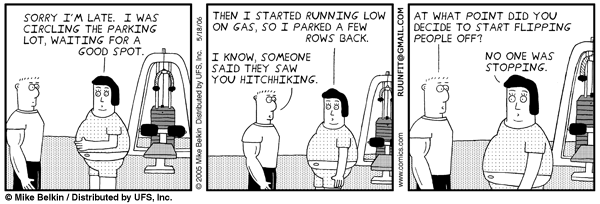 http://dilbert.com/comics/unfit/archive/unfit-20060518.html
There now - did that really take $72 million?
Tags: nz, new zealand, politics, obesity
Pick pocketed
Last year while in Madrid I had my pocket picked while on the Metro back towards our stop. It is one of those surreal experiences in which you don't really know it's happening at the time, but in hindsight you know exactly when and where it was done; and in my case by whom. Afterwards (when you actually realise that yes your wallet is gone) you feel an incredible sense of betrayal, and also stupidity: why didn't you actually realise at the time, how did you let it happen, and why did you have 250 Euros in cash in there...
The budget delivered by Labour yesterday (in New Zealand) pretty much brought back exactly the same feelings of betrayal and stupidity; how could they be spending our money on such pointless drivel, why did you still have money invested here, how did you let it happen (was there more people you could have convinced to vote otherwise), and most of all why didn't everybody actually realise at election time that this was the meandering future to which they were delivering us?
"Twelve percent of New Zealanders – 362,000 people – now pay the top tax rate that Labour promised would only affect 5% of Kiwis. They pay 51% of New Zealand's income tax"
And that is why.
Tags: nz, new zealand, tax, budget, Liarbour
Thursday, May 18, 2006
Legal system abdicates responsibility again
Hattip: NZ Herald
I am greatly disappointed by the decision of the High Court to throw out the case brought Susan Couch and Tai Hobson against the parole board. Something that this country desperately needs is greater accountability in the parole process - which I believe would instantly bring us better justice and less crime.
Please note that I am an Ignorantselfishertarian when it comes to the facts of the actual case - and I am not saying that I am disappointed that the case failed, I am disappointed that it was thrown out; that the case never had its chance to be heard on its merits and challenge the fact that parole boards currently have no consequences against them for the decisions that they make. If a parole board took joint responsibility (share any subsequent convictions?) for the actions of a criminal returned to society (for the duration of their parole period - it would be unfair for them to assume responsibility for the period after which they would have been returned anyway) you can be very sure that they would:
Take more care in their assessments of who could be returned to society
Dedicate more resources and care to the rehabilitation of criminals while in custody
Dedicate far more resources and care to the rehabilitation of criminals while on parole
Release less criminals early, and less early in their sentences.
I see all of the above consequences as being greatly beneficial to society - and surprisingly all it takes is a little personal responsibility...
Tags: nz, new zealand, justice, parole, RSA, Ignorantselfishertarian
Advice shouldn't be limited to African-Americans
Hattip: CrissCross
"Comedian Bill Cosby told a forum on family and education Tuesday night that African Americans should be proactive and fix their own communities. I have a problem with people sitting there and saying God and Jesus will find a way," Cosby said."
I have a problem with people sitting there and saying that the Government will find a way - even more I have a problem with people saying the Government should find the way.
"Cosby wasn't as biting as he was in Washington in May 2004, when he made headlines telling the NAACP Legal Defense Fund that blacks spoke poor English and spent money frivolously. But he touched on similar themes during Tuesday's panel and maintained that African Americans shouldn't blame their problems on others."
All of this is very true - and unfortauntly extends beyond the African American community. It seems to be the universal issue with virtually every "underprivileged" group in the community. Locally Maori would do well to listen to Cosby's advice - and apply it to their own situation. Beyond the racial divide, this is good advice to beneficiaries, alcoholics, criminals, etc - in this matter Cosby's comments aren't particularly insightful as to things that are particular to the African American community - but they are as to the methods by which poverty becomes a vicious cycle to those that do not take responsibility for their own situations.
Tags: nz, new zealand, beneficiaries, advice
Regulation begets regulation
Hattip: TaxBlog
The big problem with introducing legislation - especially that which is attempted to be targeted - is that invariably the loopholes and unintended consequences rely on further legislation to back it up. And so we get caught in the spiraling increase of ever increasingly complex laws and regulations. The only people who really win in this are lawyers and the IRD (due to the penalties they impose on those who inadvertently break one line of these tomes of rules).
Note that this is one of the key reasons that I support the principles of Libertarianism - because oddly enough the typical answer to the inequities created through deregulation is that further deregulation is required. Normally the problem is that another law or rule has been left in place that is creating an inequitable situation and so the answer is to remove that as well. And so we are caught in what I would see as a virtuous cycle - rather than the cycle of inertia promised by the alternative.
Tags: nz, new zealand, law
Wednesday, May 17, 2006
Sorry - use which law?
In another fantastic piece of reporting the NZ Herald tells us employers should be using the Holidays Act to crack down on fake sickies.
This is as Ruth Dyson tries to defuse the outrage from employers over their skyrocketing wage bills over public holidays due to Labour's changes to the Act. Labour managed to be its typical self when it introduced provisions in the Holidays Act that allow employees to take sick leave, but still qualify for the same rate they would have received had they gone to work; relying on the fact that employees would be good people and not screw over their employers. Which of course will never happen.
However what they manage to quote as being in the Act to help combat this is:
"An employer may require an employee to produce proof of sickness or injury for sick leave taken ... if the sickness or injury that gave rise to the leave is for a period of 3 or more consecutive calendar days, whether or not the days would otherwise be working days for the employee."
Which given that we do not have any public holidays that span 3 consecutive calendar days means that this advice is completely useless. They then state "Employers can also seek proof of illness within the three-day period if they believe the illness is being faked" - but without any backup from the Act itself.
Why do I get the impression they were trying to prove an un-proveable assertion from the Minister of Labour? It was certainly always my impression that the latter was only true where it was in the employees contract, so again sorry employers?
Tags: nz, new zealand, Liarbour, holidays act
Pies not the problem - parental responsibility is
The New Zealand Herald today complains about the "Fat still flowing over tuckshop counters" but basically misses the point that a healthy diet is not one that eschews pies / hot dogs / sausage rolls etc - but one that identifies these things as a "treat" that should be eaten on occasion and not as the staple lunch of a child. And this is where the real battle lies and so called child advocates continue to provide IMHO completely flawed advice.
The parent that gives their child money every day to buy their own lunch is instantly giving the power of choice to that child and abdicating their responsibility of ensuring that they get a healthy meal. If the school tuckshop stops selling pies and / or other foods that children do not naturally want to eat then they will just tend to hoard their money and spend it on pies after school or sweets etc. It is unlikely that a child that is given money every day has the necessary teaching and self-discipline to do otherwise.
What should also be added to this debate is the correlation between child obesity by ethnicity by parental employment status. In my school days it was certainly the case that the children who could be guaranteed to be buying tuckshop lunches each day were those with parents on the benefit. The next most likely were the "middle class kids". The rich kids were those most likely to have packed lunches of fruit / sandwiches / etc - while the "poor kids" were most likely to have fruit pottles / yoghurt / etc. I wonder how much that has changed.
The blame should not be on the schools for not providing healthy food choices - it should be on the parents. And because the food provided by tuck shops is invariably more expensive than healthy options provided from a supermarket, any arguments about them being necessary for lower income children is false.
Tags: nz, new zealand, child obesity, tuckshops
Tuesday, May 16, 2006
Chickens beaks and happiness worth $2 a week
OK - so I just killed 2 Ethopian children by making this judgment call, but I finally came to the conclusion that happier chickens with beaks and feathers was worth the extra $2 a week. Note this means I have made the switch to barn laid eggs - but not yet free range. The further $2/3 a week to give each chicken sunlight and pasture by killing another 2/3 ECU's wasn't a reprioritization that I was ready for yet.
I'm hoping that more people will slowly make this judgment move and put at least a bit of animal cruelty prevention above their need for cable / satellite tv for a couple of months (if you're like us and manage to eat a dozen eggs a week...), and slowly allow the costs of the production methods to close.
Tags: nz, new zealand, ECU, eggs, free range, barn laid
[Update] When I wrote this post this morning I had not read the NZ herald and so had not yet hit the editorial about outlawing battery cage hens. In that opinion article by Catriona MacLennan she quotes two high profile polls that "overwhelmingly support" the banning of battery cages for hens. This is the core of her argument in that the battery farming of hens should be outlawed. I disagree entirely. There is a far better poll that shows (unfortunately) that the majority of New Zealanders DO still support battery farming of eggs - and that is quote simply the number of eggs sold by farming method each week. If we did not support the practice, we would not buy those eggs and the cages would fade from existence. You see it is far easier to SAY that we are against battery farmed eggs, than to actually BE against the practice - and the consequences of its removal. I support the removal of the practice - but it should be done as I indicate in my original post - through the removal of the economics that support it, not through the unilateral legislation against something that is obviously still supported by the majority of people.If free range and barn laid eggs were not easily accessible via the supermarkets etc (like say 10 years ago) the argument might be different. But the choice is there and, sadly, most of us still say cage those hens.
An achievement of inspiration
Hattip: Stuff
Mark Inglis is one of those Kiwi's that continues to inspire and astound with his achievements.
However I hate the fact that so frequently people refer to the things he has done as being "great for an amputee" - most of his achievements are greater than what anyone else even aspire to; and to call it great for an amputee attempts to lesson the magnitude of what he has done. Sure acknowledge the fact - as this does make what he has done more impressive - but don't belittle it by suggesting that it is only great because of the amputation in 1982.
Something else that must be highlighted is how Mark shines a light on the powers of determination and attitude. Too many people blame fate or circumstance for what they do or do not achieve - while Mark belies that regardless of what life and chance throws in your way, it is your own responsibility to bring focus and achievement into your own life.
Tags: nz, New Zealand, Mark Inglis, everest, achievement, goal, life, tall poppy
How about blaming yourself?
There still seems to be a vocal backlash against the petrol outlets for the current (relatively) high cost of petrol. However people still need to look at their own consumption patterns before they can justifiably start complaining.
Last time I saw the statistics compiled for car trips in New Zealand; 1/3 of trips were under 1km, 1/3 under 5km, with the remainder over 5km duration. When you consider that the most inefficient period of fuel use for a car is the first 3 kilometers these statistics become even more damning.
While I appreciate that the car trips under 1 km are never going to be completely eliminated (we have to take disabled people and things like moving a fridge into account) - it is inexcusable to use a car to get a loaf of bread from the dairy, and then complain about the cost of fuel. The single largest driver of fuel costs is the demand - not price gouging or anything else - demand. If the demand is not there then prices will fall.
And the best way to decrease demand is to walk those small trips, and use a bike for the slightly longer ones. Oddly enough another way is to do as the (misguided) Greens are spending our money telling us to do - buy NZ made. Or at least Australian ;-)
Tags: new zealand, nz, petrol
Friday, May 12, 2006
Possums
I have to admit to being somewhat amused at both the story and the talk back around the possum that was killed at Spotswood college in New Plymouth. The fact that I went to school in New Plymouth and already had views on Spotswood from that time probably increased my personal hilarity at the story, however my views actually tend to revolve around the reporting of the story:
The possum was not "bashed to death", its skull was staved in with a hammer - these are very different deaths.
Spotswood is a high school - was this a 3rd form / 5th form / 7th form class that was involved (yes - I havent got the hang of this new "years" thing). There is a huge difference between getting a 13 year old and a 17 year old to smack in the skull of an animal.
The defense of this being no different to what these kids see on the farm - New Plymouth isn't THAT much of a hick town; most of these students ARE NOT farmers. And most farmers in the region send their kids to NPBHS / NPGHS anyway.
To those claiming trauma of the children - most of them were probably high anyway at the time - particularly if this was after Horticulture class.
All in all I say good on the teacher - what better way of teaching those invading Australians that they should be more careful where they tread...
Tags: nz, new zealand, new plymouth, possum
New Zealander's pay less tax
That's right - there is actually one tax where we are now paying less than predicted: petrol taxes.
Stuff reports: petrol tax revenue 2.9 per cent less than predicted in the nine months to the end of March, and road user charges, mainly from diesel vehicles, 4.3 per cent below forecast.
To me this is a great thing - it shows how the market is far more efficient than political interference, and more importantly it shows that higher taxes can lead to a drop in revenue.
Wow - that may come as a surprise to some of those left wingers who continue to think that dropping taxes necessitates a drop in revenue...
Tags: nz, new zealand, taxes
Wednesday, May 10, 2006
So shouldn't ALL the loops be unbundled?
An item on ZDNet caught my eye and made me think tangentially about the telecom Local Loop Unbundling (LLU) - basically it is talking about how the cable companies in the U.S. are currently facing similar unbundling threats from regulators over there and have a similar retort in terms of "we've made an investment, and I don't think the government should be coming and telling us how we can work that infrastructure, simple as that".
The query this suddenly raised in my mind was - why isn't the Government regulating for ALL the local loops to be unbundled? If there is such an economic bar to investment in the local loop then surely this means that where additional loops have been created (EG by TelstraSaturn in Wellington) then all of these should be subject to the same unbundling legislation? If fair and reasonable rental rates are to be enforced as suggested - and why Telecom's competitors are saying they shouldn't be complaining on a commercial basis - then surely those same competitors would not be disadvantaged by a compulsory rental arrangement on their own lines?
If not what REALLY is the difference? And please do not come whining about the lines never having been "sold" to Telecom - either they were and they should be theirs to charge / monopolize as they please, or they weren't and this could have been sorted out through a court case, not new legislation.
Tags: nz, new zealand, telecom, LLU, local loop unbundling, politics, legislation
Correlation and Causality
Scoop today fawns over the report Decades of Disparity III by Pete Hodgson which attempts to blame inequality in social circumstances for the inequalities in mortality rates and health outcomes in our society. This is despite it explicitly realizing: "Socio-economic inequalities explain much of ethnic inequalities in health but do not account for all the disparity."
When you are only able to explain a portion of a statistical correlation but are left with a large remainder co-efficient this is frequently a good sign that you are looking at exactly that - a correlation NOT a cause. Please note I am not disputing that poorer socioeconomic groups have poorer health - what I dispute is that the statistics PROVE that the lower socioeconomic conditions RESULT in poorer health outcomes.
Being poor does not CAUSE someone to smoke, participate in less sporting activities, or be obese - and yet these are all factors that are ALSO highly correlated with lower socioeconomic conditions - and ethnicity. I have no issue with a health policy that targets these risk factors, and in attempting to target them in an effective way means different policies may be required for different ethnic and social groups - because they frequently think and act in different ways (hence the correlation in the first place...) However for this to be effective people need to stop BLAMING the social strata as being the CAUSE of those conditions. Otherwise these people become powerless to affect the necessary changes in their own lives. It needs to be recognized that having less money does not CAUSE someone to smoke and/or drink, what needs to be found is why poorer people tend to CHOOSE to smoke / drink and give them the actual responsibility for that choice.
Tags: nz, new zealand, statistics, correlation, causality
Monday, May 08, 2006
It's a small world?
Hmmm - one of which I've only visited 11% of. Aiming at least to break 50% by the time I'm 33! How do you fare?

create your own visited countries map
Tags: meme, world, travel
Shocked and Amazed
I was witness to something in the weekend that shocked and amazed me - but on reflection I suppose I shouldn't be.
While at our local bakery to pick up lunch a Polynesian family of Mother and two sons (about 14 and 8) attempted to steal 2 large bottles of coke. This was despite the operators of the bakery picking up on the plan part way through and while the mother was paying pointedly checking that they did not want the two bottles, were not paying for the bottles and were not going to take the bottles (which had been positioned outside the fridge to one side of a cabinet). And yet the family still in a *brilliant* piece of confusion work managed to walk out with the bottles which fortunately the operators picked up on quick enough to send pursuers after the three - that even then were trying to hide the bottles.
Bottles retrieved the bakery operators didn't even bother trying to hold the 3 to prosecute - I only wish it was legal to take a photo and post an A3 flyer in the window proclaiming the 3 as thieves.
Tags: nz, new zealand, crime
Civil Defence alters procedure to account for media cockups
Hattip: Stuff
I find it amusing that the radio and TV have still not picked up on this but still seem to be mocking Civil Defence for having not "publicizing the Tsunami warning".
The key here is that:
The Ministry’s National Crisis Management Centre staff were, within ten minutes of the earthquake, in contact with the Pacific Tsunami Warning Centre in Hawaii to monitor the tsunami risk to New Zealand, and report on any action needed in Tonga or other Pacific islands. In the event there was no risk to New Zealand and no warning was issued in New Zealand.
So the problem was never Civil Defence - it was always the intial "misreporting by the BBC" - and the subsequent misreporting by other media agencies that caused any issue at all; which was the panic about a Tsunami, not the risk of a Tsunami.
In any event - if people want a more effective Civil Defence network they should probably demand that the Government funds it more than what they spend on TV ads for middle class welfare.
Tags: nz, new zealand, tsunami, civil defence
Saturday, May 06, 2006
ARL vs Kiwi's League Test
Of course I should accede out that the Kiwi's were thoroughly outplayed - but only after the bad decisions had taken their toll.
Number 1 on my list - and really the main prompt for the post - Frank Pritchards "high" tackle on Karmichael Hunt:
Realistically what was FP supposed to do - step out of his way? FP goes for shoulder tackle and KH lowers his head and runs into his shoulder. If this is upheld as a genuinely high tackle then it says that an attacker can run his own head into a defender and claim a penalty as a result.
Turnaround from this madness: Nigel Vagana called back from scoring an under the posts try, Kangaroos penalty from which they score, and a free interchange for the kangas.
Number 2 - the from the ground pass leading to a try:
Okay - I accept that within the letter of the law that pass was legal - but then the officials shouldn't have penalised Cayless at the far end of the field for a "flop" - same situation player had not touched the ground with the ball carrying arm but would normally be considered "tackled". And that is what it is about - if they are going to allow the passing from the ground they need to accept that the defending team has the right to continue a tackle until the guy is either flat on the ground or tackle is called. Okay - this one is more a bitch than genuinely bad reffing.
Number 3 - bundle together (because I don't want to spend all day on this post) "that" missing offside call (how could you miss that?), how were no forward passes called (maybe the officials forgot about that rule?), and after admirably setting the standard of clearing the ruck (costing the Kiwi's 2 penalties - no issue with that) spectacularly failing to enforce that standard.
Now please note - I'm actually not blaming the ref on this one - most of the worst calls (and absent calls) were touch judge calls. And this is an area of League that does not get enought focus - sure we roast the ref's for their high profile mistakes but it is the cold reality that the touchies are the bane of the games progression. They are not fit enough, do not know the rules well enough and are generally incompetent.
I would really welcome a move to a 4 touch judge system both in the NRL and for international tests - one for each half of each sideline and think that the quality of the officiating would improve drastically as a result.
Hopefully next time these two sides meet it can be a 13 on 13 match.
Friday, May 05, 2006
IRD miscalculations - does that surprise anyone?
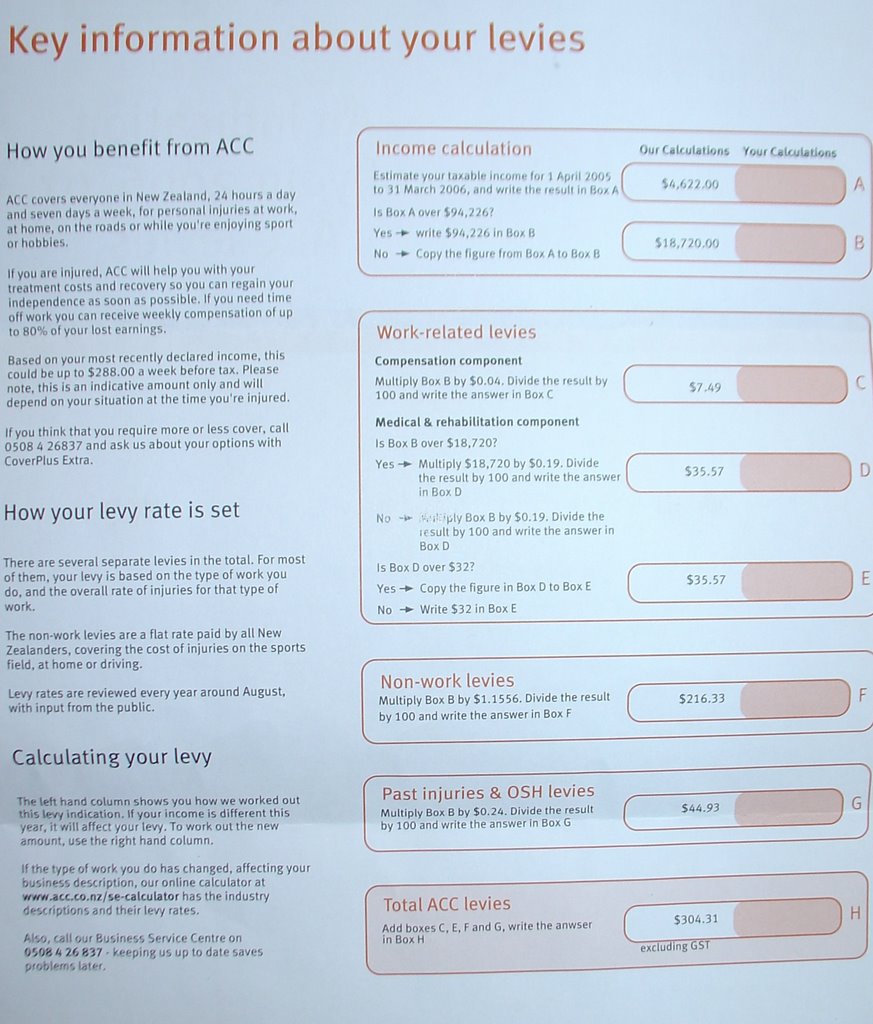
So can anyone spot the (obvious) mistake? Hint - you really don't need a calculator for this one...
Thursday, May 04, 2006
Telecom Local Loop unbundling - who actually expects to benefit?
Much of the public relations mantra about why we need to do the LLU of Telecom revolves around the fact that we need this faster / cheaper broadband in businesses and schools to take advantage of the new business models available; and teaching opportunities available.
What I find interesting is how many people buy into that.
LLU only stands to improve dialup and DSL access / prices - what other broadband would run across Telecom owned copper? Ignoring the former - I'm sure everyone agrees that this was never about lowering the price of dialup access further (although that may act as a further broadband disincentive for the home) - ask yourself how appropriate DSL is for businesses and schools?
DSL has been the best price performance choice for quite some time now - even in the business world - and yet relatively few businesses use it, why? Because the underlying TECHNOLOGY is relatively inappropriate for business use - restrictions on IP address assignments / latency / jitter / high attenuation loss of signal / high packet loss / etc.
This is why initiatives like CityLink in Auckland and Wellington have thrived (and tell me how even an 8MB DSL line with its PPPOA overhead is going to compete with a direct Gigabit Ethernet connection?). Why businesses still have ISDN lines, why frame-relay still exists. More importantly why direct to business fiber connections are becoming increasingly common; because DSL just doesn't cut it in most cases.
Back to the schools - same thing applies. In fact most schools I know have Telecom falling over itself to get direct fiber in there - why? Because they can reap far better returns from that where there is a reasonable number of computers connected than over a shared DSL connection. And they don't want schools dealing with the instability of a DSL solution.
So your home stands to benefit - right? WRONG (in most cases). This will just lead to a further compartmentalization of pricing like we see now in phone lines where Wellington gets its phone rental cheaper because TelstraSaturn happens to compete in that one place. Competition with LLU will still only occur on an Exchange by Exchange basis - and unless you happen to be linked to an exchange that can be cherry picked it is unlikely to affect you. Which will probably mean HIGHER prices for those people linked to Exchanges that the other ISPs don't want to compete over.
Good luck seeing broadband in those rural exchanges now this century...
Tags: nz, new zealand, nationalisation, Telecom, DSL, regulation, monopoly
Tsunami warning
For about an hour this morning there was an active Tsunami warning for New Zealand - as reported on NewsTalk ZB at 5 o'clock this morning (when we happen to be getting up for work). For us this really was no undue concern - evaluating our risks:
Tsunami from the north - would have to cross Auckland city and about 10km of ground to reach us
Tsunami from the west - would be really impressive having crossed 40km of ground and bypassed a couple of small volcanoes.
Tsunami from the east - more impressive, with the entire Coromandel peninsula having acted as a buffer...
However I am pretty sure some people wouldn't be able to think quite that rationally through their own risks and I wonder what undue panic was caused out there by this being broadcast repeatedly on a nationwide radio station.
Later on after the alert was cancelled Paul Holmes was patting themselves on the back and asking "where Civil Defence was after NewsTalk ZB had to wake everyone up to the news." I would suggest possibly only in the towns actually at risk (Gisbourne etc); and probably assessing the fact that the warning was still that there was a possibility of a Tsunami heading somewhere from off our East Coast - rather than alarming the whole nation about a vague and (for most people) non-existent threat.
I would have less derision if they had actually specified the direction / place of the Tsunami with each broadcast of the warning - but there was only one that specified that it "would hit Gisbourne first", the others were for a Tsunami warning for "New Zealand"
Tags: nz, new zealand, tsunami, newstalkzb
Wednesday, May 03, 2006
Ill-educated privacy fears around RFID
Hattip: Wired
Wired is reporting on how IBM has released a "new" RFID tag that allows a consumer to rip off part of the antennae to reduce the range of the device while retaining the tags usability. I love the quote from Robert Atkinson (president of the Information Technology and Innovation Foundation):
"The Clipped Tag shows that IBM is addressing privacy concerns, even those that are unreasonable" basically showing the derision of the industry towards privacy groups such as Caspian - who provide information like:
"While highly useful, some critics worry that RFID tags could expose individuals to privacy risks. For example, information sent wirelessly could be intercepted and deciphered by someone with the appropriate tools and skills, with little chance of detection. Since the unique RFID serial numbers on purchased goods -- called electronic product codes -- will be matched with credit card and customer loyalty card numbers in databases, the RFID tags could be used by marketers and spies to track individual consumers"
However this completely ignores the fact that the intercepting person needs access to the database with that relationship in to know it. Ignores the fact that RFID tags rely on their antennae not only for the transmission / receipt of signal, but also to induct the power to make the response. IE they are very sensitive and something like washing your clothes is likely to destroy most of the tags. And that even ignoring that - the tracking of an individual by their Credit Card / Loyalty Card does not need RFID - and is already done.
And the privacy advocates also conveniently ignore that most organisations are still finding it difficult to justify the cost of RFID tags at the pallet level - let alone the individual item. Furthermore the types of large stores (Walmart / Toys R Us / etc) that could be realistically assumed to have datacentres able to process this type of information - are already struggling under the load of processing their sales orders and purchase orders. Adding the data-mining complexity of terrabytes of data that someone has come into the store wearing something they MAY have bought here before just is not that likely.
But personally - when it is possible - I welcome the possibility that I will only get approached by a store salesperson that is only going to bug me about things that I might be remotely interested in...
Tags: RFID, ignorance , privacy
Bad Weather Cycling
OK - I was dreading today as the first actually bad weather that I was going to bike to work in. However I've found that at the end of it all you actually feel better for the exercise in the cr*p weather - than having wrapped yourself all snug in the car anyway. Admittedly if it was further to my work I might feel differently...
I have decided that my cycling road code is a little rusty however - and I'm somewhat perplexed as to where a cyclist is supposed to go in certain intersections without drastically reducing their life expectancy. Can anyone tell me the best way to negotiate an intersection with 3 lanes (when I need to turn right):
* left hand lane dedicated to left turning traffic
* center lane for straight ahead AND right turning traffic
* right hand lane dedicated to right turning traffic
So far contemplating the options has led to me dismounting and crossing with the pedestrian signals...
Tags: nz, New Zealand, rode code, cycling, bike
Tuesday, May 02, 2006
Opposition to Wayne Mapp's bill shows its necessity
Through my partner I frequent a place of employment with a high proportion of staff receiving youth rates, minimum wage and rates just above the minimum wage. The interesting thing that I have found recently since the introduction of Wayne Mapp's bill (Employment Relations (Probationary Employment) Amendment Bill) to parliament is who is in support or opposition to it.
Almost universally the "workers" are in support, while the "employees" are not. My differentiation really just being on the basis of my observation of who actually works and who just turn up do the hours and go home. In the latter category are those that I can tell my wife were absent from her work without having been there that day - just by what day of week it was. It is those that when she is telling me of a staff stuff up (and consequent customer complaint), I can accurately guess who it was by the nature of the mistakes. It is that recently departed staff member who was fired because of time clock fraud. It is the staff member that was attempted to be fired for job abandonment - but was saved by a procedural mistake (but incidentally is back to their second written warning within 2 weeks of that).
From this place of "employment" I see widespread opposition to Wayne Mapp's proposed provisional period - and the opposition only makes me more determined that it is absolutely required.
Tags: nz, New Zealand, politics, Wayne Mapp, Employment Relations (Probationary Employment) Amendment Bill
Monday, May 01, 2006
Oil companies not necessarily the profiteers they are made out to be
Ces't Moi has a good run down on the state of the blame game from a US perspective: http://lesbiencestmoi.blogspot.com/2006/04/on-oil-we-should-shoot-messenger.html
but most importantly raises the following point:
"profits for the oil companies are sure up in the 2006 first quarter but before you draw your sword, would you be surprised to find out that Yahoo first quarter earnings are more than double the oil company's earnings?"
From a New Zealand perspective would you be surprised to know that BP only makes double the NZRU's earnings?
That really does not show Oligopolistic profiteering to me from the oil companies over a fungible commodity.
Tags: oil, petrol, gas, nz, New Zealand, oligopoly, BP
[Update] I even forgot to mention that Ces't Moi is a typically left wing environmentalist blog - so in defending the oil companies is showing more sense than normal ;-)
Surprise, Surprise - making the pipe into the home bigger doesn't lead to faster access
Hattip: Computerworld
"High contention rates (or the number of customers sharing the available bandwidth) have been cited as the major reason for current discontent, since they cause peak-time congestion, with severely degraded performance."
I seem to recall saying before that increasing the pipe into the home wouldn't do anything until the backbone speeds were increased. And what incentive does Telecom have to increase the backbone speeds at the moment - none. With the "kiwishare" and calls for nationalization of the local loop acting as a huge disincentive towards any kind of infra structural investment I really don't see this changing any time soon.
And to repeat - forcing Telecom to release the local loop and/or give "faster, cheaper broadband" to the home is not going to make anyone's Internet access move any faster.
Tags: nz, New Zealand, Telecom, internet, broadband
Worriers lose but show why I watch them again ;-)
OK - so we got caned by the doggies on the final score line - but despite the Warriors playing atrociously for most of the game they still looked like they could pull it off for most of the time. Which makes for an exciting game. Which oddly enough in the New Zealand psyche is better than a won game.
Still while it was nice to have one doggie (finally) sent off for repeated infringements - it would be even nicer to see the bins keep coming when the infringing continues...
Meanwhile it appears my soccer team had a better result over the weekend beating top of the table Three Kings United 2 Inter with 4 goals to nil ;-) In a way it's kind of depressing to get a great result like that when you're not there though... Gets us to 3rd on the ladder (Auckland Mens Div 2, University-Mt Wellington 2 Warriors for anyone interested).
Tags: nz, New Zealand, soccer, warriors, NRL

